


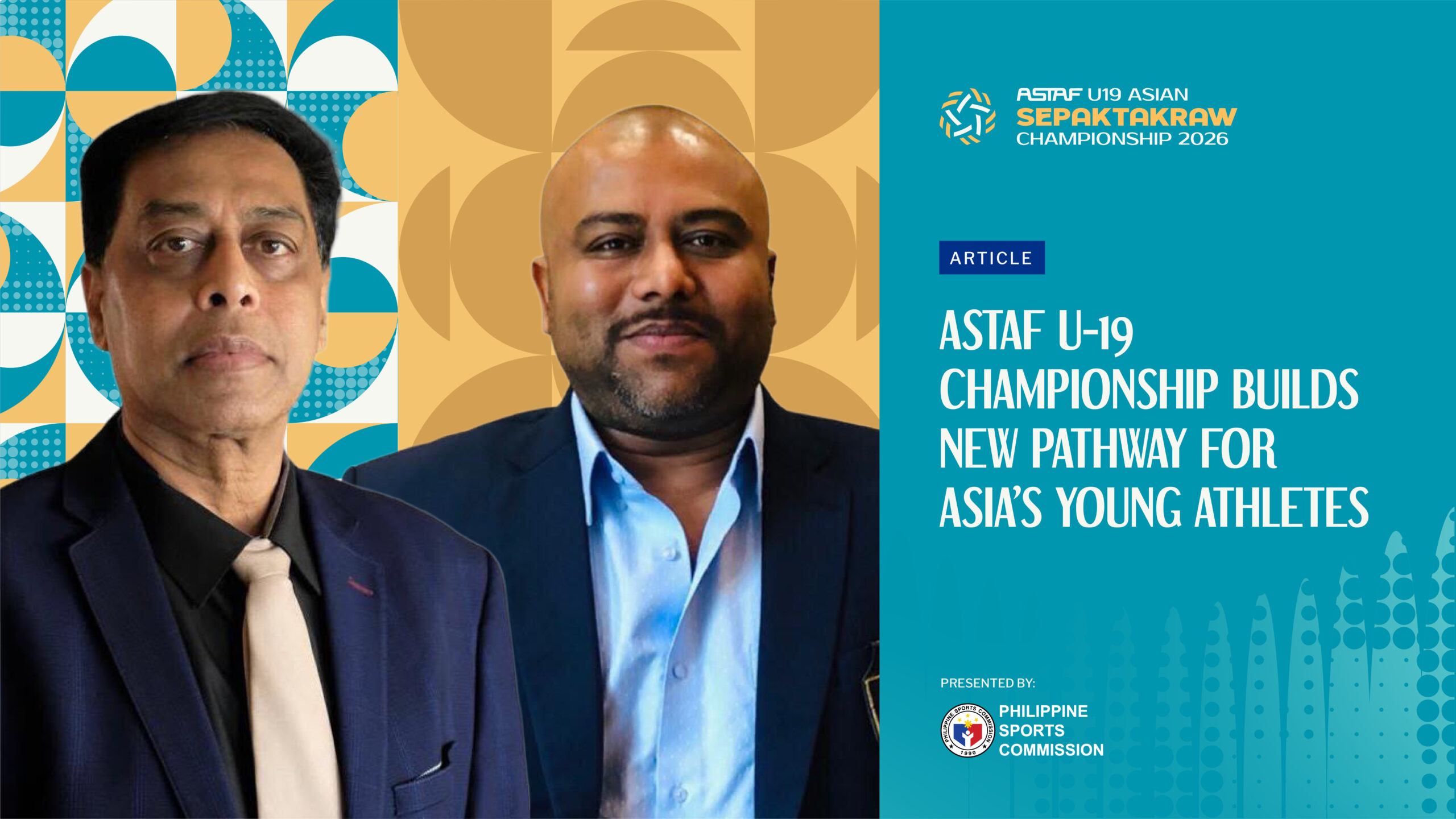
ASTAF President Dato’ Abdul Halim bin Kader (left) and his son, ASTAF Deputy Secretary General Muhammad Fariq Abdul Halim (right)..
Young sepaktakraw players from across Asia will have a continental championship of their own when the Asian Sepaktakraw Federation (ASTAF) stages the inaugural U-19 Asian Sepaktakraw Championship from November 26 to 30, 2026, in Manila.
Presented by the Philippine Sports Commission (PSC) and hosted by the Pilipinas Sepaktakraw Association, Inc. (PSTAI), the tournament gives national federations a place to field junior teams and assess how their players compete internationally.
“For many years, our international competitions have largely focused on senior national teams,” said Muhammad Fariq Abdul Halim, the event’s technical delegate and deputy president of the International Sepaktakraw Federation (ISTAF). “We believe the time has come to strengthen the foundation of our sport by giving younger athletes the opportunity to represent their countries, gain international experience and develop their potential from an early age.”
He said it was a challenge to encourage teams to join the inaugural championship because youth development remains at different stages across ASTAF’s member federations. The ASTAF U-19 Asian Sepaktakraw Championship gives those federations a goal to work toward as they build up their junior programs.
Muhammad Fariq also said the goal is for every ASTAF member federation to give young players a clear path from grassroots programs through youth competition to their senior national teams.
“These young athletes are not merely the future of Sepaktakraw; they are the foundation upon which we must build the international growth of our sport,” he said.
Two generations of sepaktakraw leadership
Muhammad Fariq and his father, ASTAF President Dato’ Abdul Halim bin Kader, both serve in the sport’s Asian and international federations.
Dato’ Abdul Halim became general secretary of the Singapore Sepaktakraw Federation in 1982 and later served two terms as its president. He is also ISTAF’s secretary general. On November 9, 2026, ASTAF announced that he had retained its presidency unopposed. His community work in Singapore includes helping establish Yayasan MENDAKI, which supports education in the Malay/Muslim community, and Taman Bacaan, which promotes literacy and youth development.
Muhammad Fariq is ASTAF’s deputy secretary general. His experience includes serving as a vice-chairman of the steering committee for the 2026 ISTAF Sepaktakraw World Cup in Kuala Lumpur. Last March, he met with the Asian Volleyball Confederation in Bangkok in his capacity as ISTAF deputy president to discuss sports and event development.
Preparing for the SEA Games and Asian Games
In a statement to the media, Dato’ Abdul Halim explained what junior players stand to gain from competing in Manila.
“The purpose of introducing the U-19 Asian Championship is to give these young athletes early exposure to international competition,” Dato’ Abdul Halim explained. “They must learn to compete under pressure, understand the demands of international competition and gain the experience necessary before progressing to the senior level.”
Dato’ Abdul Halim believes national federations should already start preparing for the 2030 Asian Games in Doha, where six gold medals have been proposed for sepaktakraw. He said some of the juniors competing in Manila this month could even go on to represent their countries in Doha. The ASTAF U-19 Asian Sepaktakraw Championship also offers the Southeast Asian members of the federation an opportunity to prepare their young players for future SEA Games.
Dato’ Abdul Halim said federations should judge their youth programs by how many players they can develop and keep in the sport over time, regardless of gender. “We must give equal attention to the development of boys and girls. Every young athlete, regardless of which country they come from, deserves the opportunity to compete and realise their full potential,” he said.
Meanwhile, Muhammad Fariq thanked the Philippine hosts for making the first edition possible.
“I would also like to express our sincere appreciation to the Philippines, particularly the Pilipinas Sepaktakraw Association, Inc. and its Organising Committee, for taking on the responsibility of hosting this inaugural Championship. Their commitment provides an important platform for the next generation and marks the beginning of what we hope will become a lasting tradition of youth development throughout Asia,” Muhammad Fariq said.