


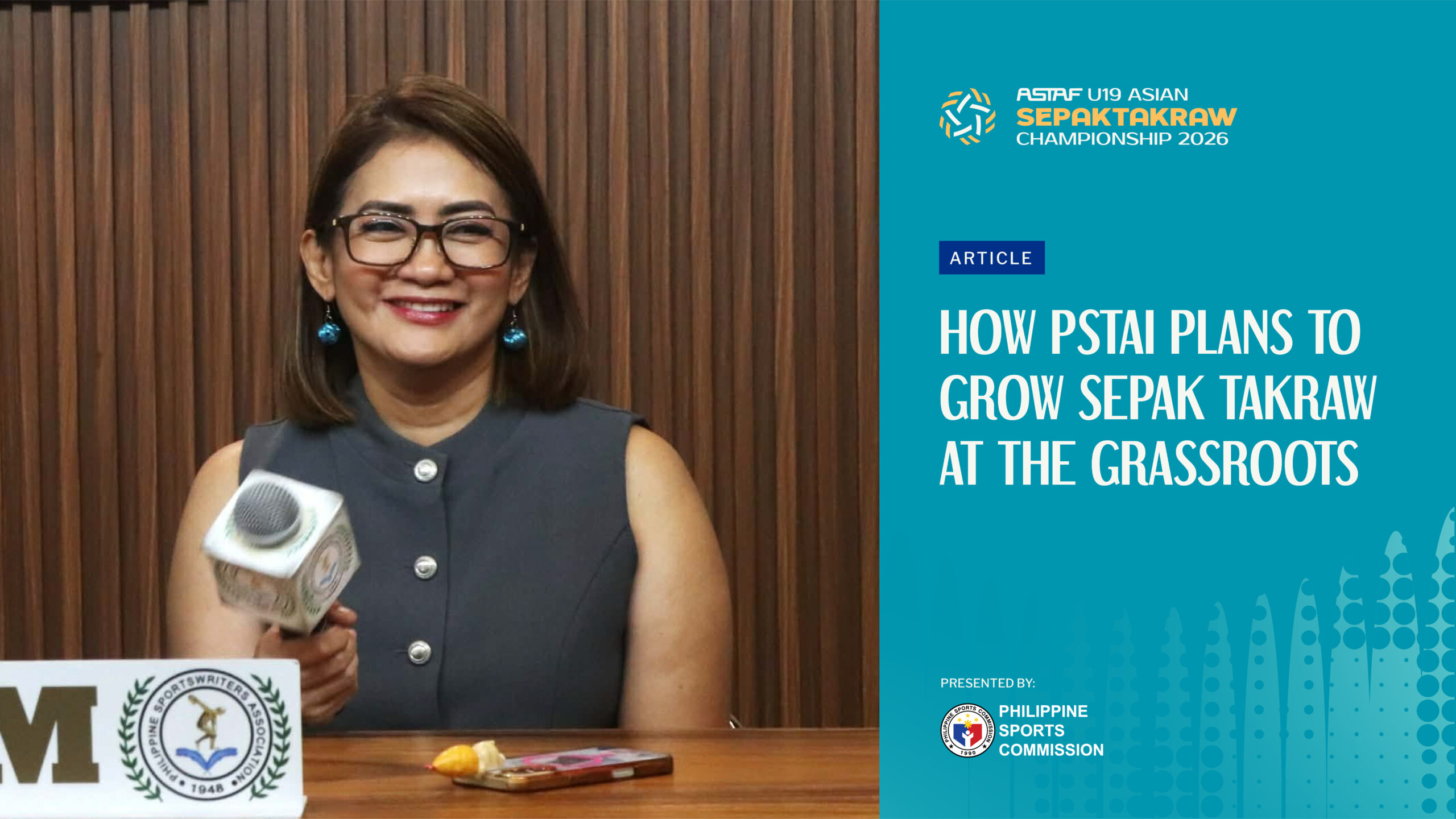
PSTAI President Karen Claire Tanchanco-Caballero believes opportunity, like talent, should be everywhere.
A young player might first try sepaktakraw at a school clinic. Where can they go for their next practice?
The Pilipinas Sepaktakraw Association, Inc. (PSTAI) wants the answer to be somewhere close to home. Under its proposed three-year grassroots development plan, the association would work with schools, barangays, and regional partners to bring regular training sessions to communities where children and aspiring athletes have limited access to organized sports.
PSTAI already runs regional training centers, youth development camps, and local competitions. The association plans to work with its regional partners to decide which communities need to be prioritized. Clinics and camps would introduce young players to the game, while regular sessions would give them time to practice and develop their skills.
“Talent is everywhere. Opportunity should be too,” said PSTAI President Karen Claire Tanchanco-Caballero.
Local tournaments would give youngsters a chance to compete and help coaches spot promising athletes early. Regional training centers could then help those players get ready for regional and national competition.
Caballero also wants development programs to incorporate proper nutrition, athlete welfare, and safeguarding alongside technical training. To support the people who run those programs, PSTAI plans to work with national and international partners to strengthen coaches’ education, technical workshops, and officiating programs.
Caballero credited the Philippine Sports Commission (PSC) with providing institutional support for grassroots development. Asked if the association would also pursue partnerships with local government units (LGUs) at the city, municipal, and barangay levels, she was emphatic.
“Definitely. In fact, this is central to our sustainability plan,” Caballero said. “We’re working toward partnerships where PSTAI provides technical guidance, the PSC supports development initiatives, and LGUs help us sustain local implementation. We want shared ownership because grassroots development cannot be the responsibility of the NSA alone.”
“The PSC provides important institutional support, while LGUs, schools, and local partners help bring the programs directly to communities,” Caballero explained.
She also revealed how PSTAI plans to measure progress. “We want to measure success not just by medals, but by participation, active training centers, trained coaches, and athletes progressing through the development pathway. That’s how we know we’re building something meaningful.”
The inaugural ASTAF U-19 Asian Sepaktakraw Championship 2026, presented by the PSC, gives the association a chance to put its plan in motion. Caballero called hosting the championship “an opportunity to inspire the next generation and leave something meaningful behind.”
She added, “PSTAI’s legacy initiatives include equipment donations, technical education, stronger local partnerships, and a three-year grassroots development roadmap. We don’t want the impact to end when the final match is played. We want the championship to become a starting point for more young Filipinos to discover, play, and eventually excel in sepaktakraw.”
Caballero also said the association’s guiding principle is that grassroots development isn’t about the number of activities it organizes.
“It’s about how many opportunities we create, how many lives we touch, and how well we sustain these programs long after the events are over.”